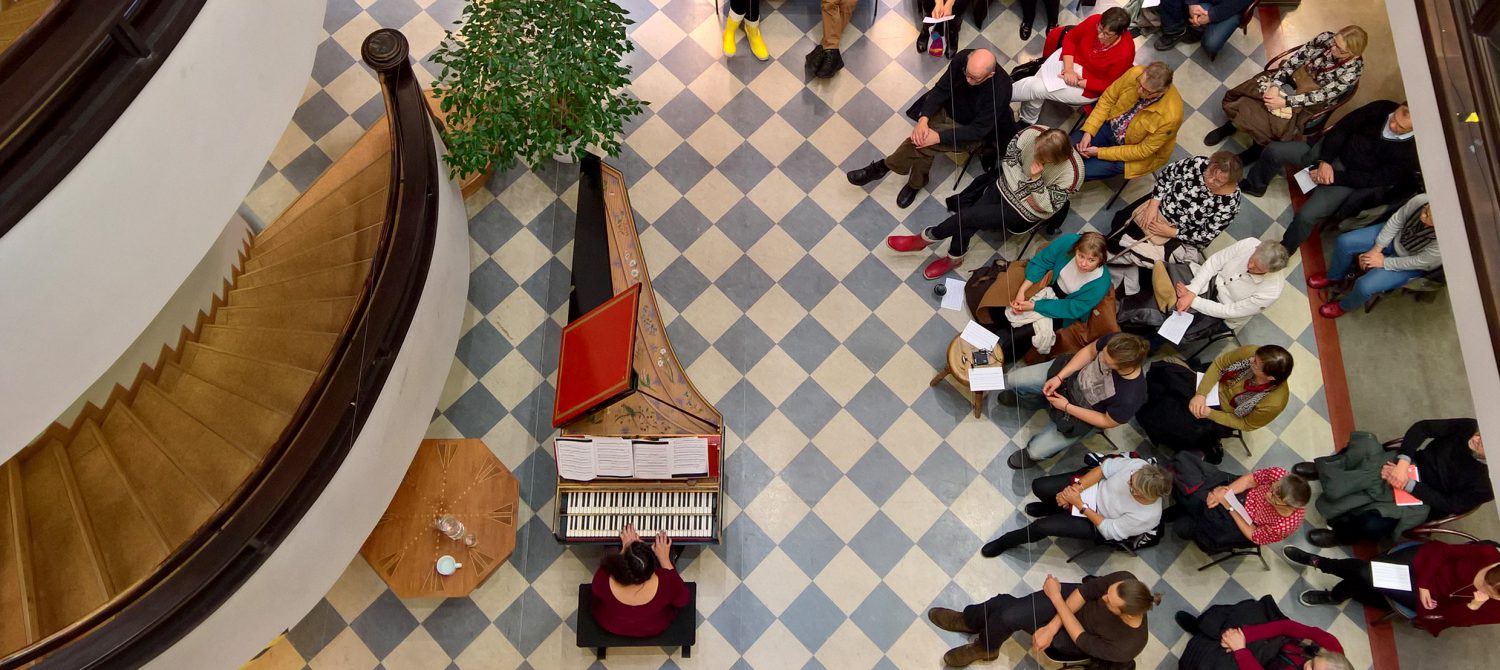
Programme
Johann Sebastian Bach (1685–1750) – French suite IV in E flat major, BWV815
Allemande – Courante – Sarabande – Gavotte – Menuet – Air – Gigue
Girolamo Alessandro Frescobaldi (1583–1643) – Toccata Prima in g minor, from Toccate e partite d’intavolatura, Libro 2 (1627)
Louis Couperin (1626–1661) – Suite of dances in d minor
Allemande – Courante – Sarabande – Gigue
Giovanni Picchi (1571/1572–1643) – Toccata in d minor, found in the Fitzwilliam Virginal Book.
Johann Sebastian Bach (1685–1750) – Sonata for viola da gamba and obbligato harpsichord in g minor, BWV1029
Vivace – Adagio – Allegro
Notes
The harpsichord is old, its roots go back far and stretch themselves all over Europe. The first time the world heard about it was in 1397, when a Paduan jurist wrote of a new instrument, allegedly invented by one Hermann Poll – a doctor and musician from Vienna. What if we could have the plucked string sound of a lute or a psaltery, but played with the keyboard of an organ? The resulting instrument was called clavicembalum. Twenty-eight years later we can find a depiction of this new creature as part of an altarpiece in north-west Germany in 1425. The old-Italian name for it: arpicordo.
The harpsichord is old, its roots go back far and stretch themselves all over Europe. Many stories could be told about it, with it, through it. This concert is one of them.
***
We start the concert with a so-called French suite by J.S. Bach (1685–1750); of these, Bach wrote six in total and I’m playing the fourth. I say ‘so-called’, because Bach didn’t call them ‘French’ himself and the extent to which this music is in a French style is also arguable. Bach wrote these suites around 1722, while living in Köthen serving as Kapellmeister to Prince Leopold of Anhalt-Köthen. He had recently married his second wife Anna Magdalena Wilcke, a very good soprano who performed at court. After their marriage, Johann Sebastian started giving Anna Magdalena keyboard lessons, and wrote music especially for her in a Notenbüchlein für Anna Magdalena Bach, including tonight’s suite. These suites are part of the core repertoire for keyboard players: to this day, all keyboard musicians play at least one. To choose one of the six I played through all of them, and eventually chose the fourth because when I started playing the Allemande, I felt a sense of comfort and grace. It also so happens that I also find E flat major a very beautiful key.
Toccatas are also part of central keyboard repertoire, and we have two very fine examples in tonight’s programme. But first, what is a toccata? A piece written in such a musical style as to emphasise the virtuosity of the person performing it – which entails lots of fast and freestyle passages, alternated with polyphonic passages that are more melodic. An improvisatory aspect is also included. So basically, this is the music with which keyboardists show off how cool and fast they are, but also how sensitive.
The first of our two toccatas tonight is this Toccata Prima in g minor written by G.A. Frescobaldi (1583–1643): we are moving a century back in time (the piece can be found in a book of Frescobaldi’s music published in 1627) – and we are travelling geographically to the south, to Italy, to Rome to be precise: the city where Frescobaldi moved in the early 1600s to spend a large part of his life. Frescobaldi was known as a genius keyboard composer and performer, and he influenced many musicians. An important student of Frescobaldi’s was J.J. Froberger (1616-1667), who contributed greatly to the development and standardisation of the keyboard suite. I underwent quite a process with this piece because when I started working on it, I felt that I didn’t understand this music at all. But now I really enjoy its twists and turns and suddenness; to enjoy how it doesn’t make sense in the way other music does, but makes sense nonetheless. If that makes sense?
Frescobaldi’s student Froberger visited Paris in 1651/1652, where he met L. Couperin (1626–1661), becoming a major influence on the latter’s composing style. We therefore come to our second suite of the evening, written by Couperin in the key of d minor. So perhaps now is the time to mention that a suite is a series of dance movements, and Froberger was among the composers who established that the dances always to be a part of a suite are allemande, courante, sarabande and gigue. I thought that after first playing a suite called a ‘French suite’ in this concert, it would be nice to also bring you a suite written by an actual French composer, to compare and contrast. Couperin lived mainly in Paris as an organist, composer and violist. At the time, the different dances of a suite weren’t organised in order in advance, by which I mean that – rather than Bach’s French suites, where all the dances were composed in connection to each other – there weren’t specific allemandes that belonged to specific courantes and other dances. You could play any gigue after any sarabande, as long they were in the same key. So to put together a full suite, you simply picked your favourite composition of a dance movement from a collection, copied them out by hand, and voilà, your very own suite. I did the same for tonight.
For our next piece we have another toccata, this one written by G. Picchi (1571/1572–1643) in d minor. Picchi lived slightly before Frescobaldi, but more important is the difference in location – Picchi lived in Venice, which at this time was a separate city-state. He served as an organist in church and scuola from 1606 till his death, and established himself as a composer, lutenist and harpsichordist. This particular piece comes from the Fitzwilliam Virginal Book, a collection of mainly English music written between 1562 to 1612. Composers such as Bull, Byrd and Philips feature heavily, and we find the occasional piece by Dutch composer Sweelinck. Yet among all this Englishness and occasional Dutchness we come upon this one piece by Picchi, the only Italian piece, out of a total of 297. So the obvious question is, how did Picchi’s piece end up in this collection, especially since he didn’t travel? And the answer to that is … we have no idea. This mystery is one of the reasons why I wanted to play this piece. The other is that though the virginalists and Sweelinck have a special place in my heart, unfortunately I couldn’t include any of their music in this programme. But I could somehow feature something from the Fitzwilliam Virginal Book, and as pieces from this collection are what I originally started with on the harpsichord, playing this specific Picchi makes me feel quite close to that love of my heart.
For the end of this concert we come back to Bach with the g minor sonata for viola da gamba and obbligato harpsichord. This is a very different kind of Bach than what we heard at the beginning of the concert, and that is an important reason for why I chose this piece. The sonatas for viola da gamba and harpsichord were written approximately in the late 1730s/the early 1740s, so at least 15 years later than the French suite you heard earlier. Bach had been living in Leipzig as cantor of the Thomasschule at the Thomaskirche since 1723 – providing music to four churches and teaching students of the school. He held this position until his death, and wrote much music beyond what he was required to do as part of his job. During this last part of his life, Bach was inspired by an older polyphonic style (stile antico) and we can hear this in the music he wrote then, including in this gamba sonata. This is big, forceful, epic music, very different from the intimacy in which we started the concert. I really enjoy getting to show both these sides of Bach to you. I would also like to thank my colleague and dear friend Vadim for having the courage and the determination to play this piece with me.
***
To return to stories and roots and stretching: this concert also tells a story about me. I came to Finland from the Netherlands in the autumn of 2014, and now, in this darkest time of the year 2018, I am graduating as a bachelor in harpsichord playing from the Sibelius Academy. In 2014 I didn’t imagine this 2018. Much has happened in these last four-and-a-half years. There is a great journey behind–and also, I hope, a great journey ahead. I learned that the Finnish word for this time of year is kaamos, and that now is the time to wish someone a hyvää joulunodotusaikaa. I learned that I love the harpsichord, what it can sound like, what its function can be, what it represents, what stories can be told with it. I learned that I love playing with other people and serving, but that it’s also possible to serve as a soloist. I learned that one can fall many times, and that the key to getting back up is to be ok with that. And that it’s important to grab the hands offered to you when you’re on the floor but it’s also important to push yourself up from there.
I really like that the Finnish word for Bachelor is kandidaatti, candidate. The next step is maisteri, or master, but before you can become a master, you have to be a candidate. This concert and the one I played two months ago represents me becoming a candidate. And being a candidate, I find, is a beautiful thing. All of this is an ongoing process – tonight is one moment in it. I am grateful and glad for the experience, to walk this path, and I am glad that you all are here to witness it. Thank you.
***
Instruments and tuning
The big red harpsichord on which I played both pieces by Bach and the suite by Couperin is a double-manuel instrument in the French style. The smaller dark green harpsichord is a single-manual in the older Flemish style. Both instruments were built by Henk van Schevikhoven (Delft 1947- Porvoo 1999) – a Dutch harpsichord builder who moved to Finland in 1980. The French harpsichord was tuned in the Mercadier system, and the Flemish in ¼ comma meantone.
Editions used
Johann Sebastian Bach Französische Suiten BWV 812-817, edited by Rudolf Steglich, published in 1972 by G. Henle Verlag.
G. Frescobaldi Toccate Libro 2, edited by Kenneth Gilbert, published in 1979 by G. Zanibon.
Louis Couperin Pièces de Clavecin published by Paul Brunold, new revision by Davitt Moroney, published in 1985 by Éditions de L’Oiseau-Lyre.
The Fitzwilliam Virginal Book edited by Blanche Winogron, Volume I of two volumes, published by Dover Publications, Inc. in 1979-1980. The Fitzwilliam Virginal Book itself contains mainly English keyboard music from approximately 1562 to 1612.
Neue Bach-Ausgabe, Serie VI. Kammermusik Band 4: Drei Sonaten für Viola da gamba und Cembalo, edited by Hans Eppstein, published in 1984 by Kassel: Bärenreiter Verlag. Accessed via imslp.org.
 Eugenie Touma van der Meulen